
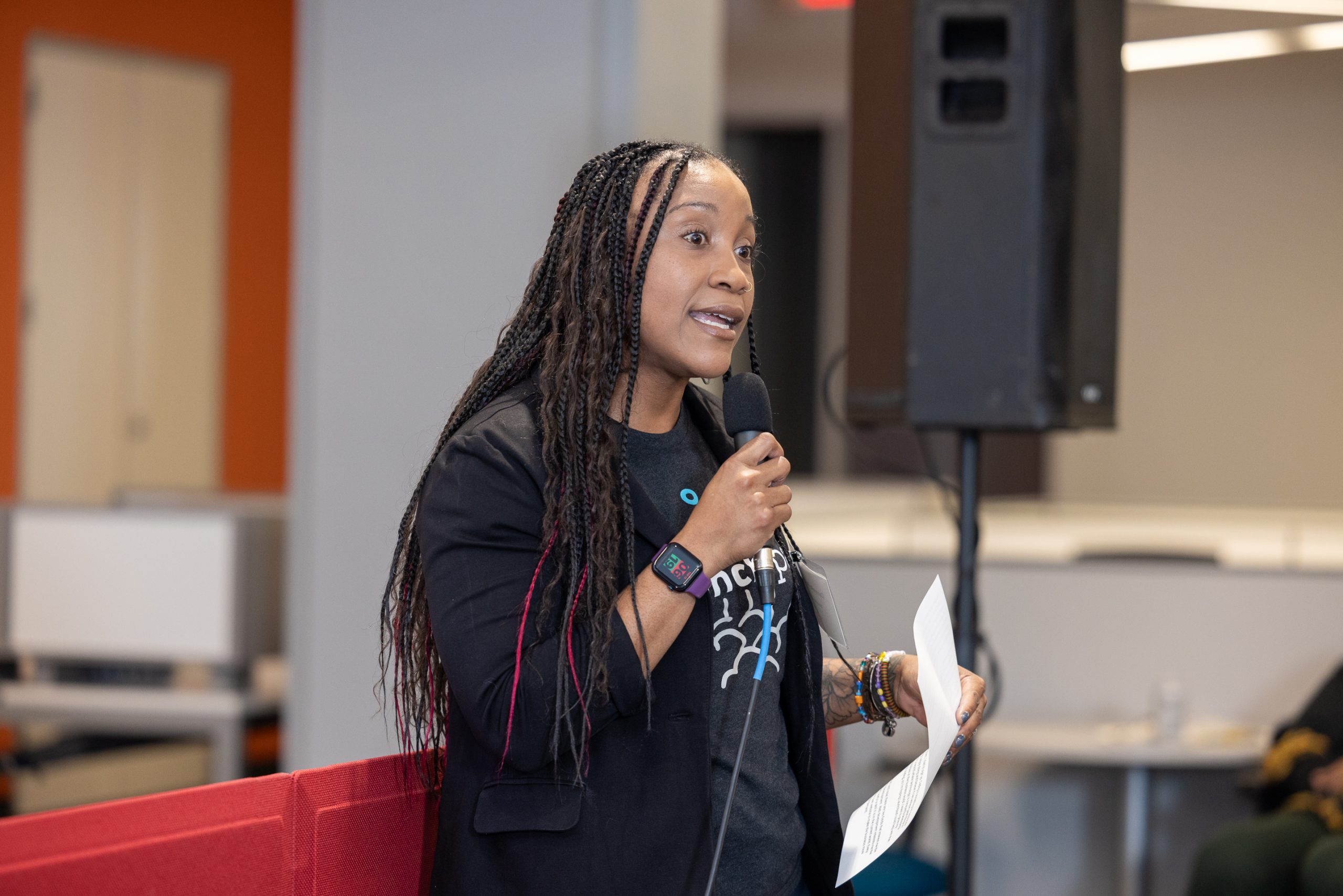
As Women’s History Month comes to a close and Black History Month remains fresh in our minds, I find myself standing at the intersection of my identity as a Black woman leader of Launchpad. It’s a space that feels both deeply personal and profoundly impactful. This moment reminds me of the power of reflection, the importance of representation, and the critical work of creating meaningful pathways into high-paying tech careers for young people—work that feels even more urgent as we face ongoing attacks on diversity, equity, and inclusion.
At Launchpad, our mission is clear: to build accelerated pathways that create economic mobility for Black and Brown youth. It’s not just about training—it’s about voice and choice. Too often, young people are robbed of their ability to make decisions about their own futures.

The response to youth, especially those from underresourced communities, is frequently one of restriction and prohibition rather than possibility and exploration. But we believe the path to economic mobility starts with agency—with opportunities that spark curiosity, speak to their passions, and propel them toward their goals. It’s not enough to open doors; we have to ensure young people have the freedom and support to choose which ones to walk through. That belief isn’t just something I talk about—it’s something I live.
Next year, I’ll have four kids at four different schools, each with their own interests, strengths, and dreams. As a mother, I know firsthand that every young person’s journey is unique. Honestly, with four sets of report card conferences, I might need AI to attend a few on my behalf—if only it could nod thoughtfully and ask, “But how are they doing socially?” Just like my own kids, the young people we work with at Launchpad are navigating their own paths, making choices that reflect their goals and realities. Our role as adults and leaders isn’t to dictate their next steps—it’s to walk beside them as they explore the different pathways ahead and ultimately decide what is right for them at that moment.

The same holds true for the Associates in our programs at Launchpad. Some may aspire to a four-year degree, while others are eager to step directly into high-paying careers. Some will go off to college, while others will choose to stay close to home and grow with us as they build their futures. Our job is not to decide for them—it’s to offer bold, intentional pathways that let them choose their future with confidence. Real-world skills, paid internships, industry credentials, and mentorships—these aren’t extras; they’re essentials.
I think back to my own journey and the mentors who shaped my path. When I was transitioning into high school, my mother enrolled me in the Women In Natural Sciences program—less because of my love for science and more because she wanted to keep me engaged in opportunities that would keep me on a good path. It was there that I met a mentor who was intentional about pushing us outside of our comfort zones. She designed experiences that forced us to grow—canoeing down rivers, sleeping in tents, and visiting colleges like Franklin & Marshall, where I would later enroll full-time after graduation. More than just a mentor, she nurtured relationships—not only the relationship we had with her but also the bonds we formed with other girls in the program. To this day, one of my closest friends came from that experience.
But beyond the friendships and outdoor adventures, what truly left a mark was how that program opened my eyes to the idea of a future I could build for myself. For the first time, I didn’t just see a career as an abstract concept—I saw it embodied in my mentor. I saw someone who supported young people, who sparked our curiosity and excitement about what we could become. I knew I wanted to do the same. At first, I thought that meant following in her footsteps by majoring in environmental science—until I took my first sociology class, and everything clicked.
Sociology 101 was the first time someone helped me see that my struggles weren’t just personal—they were deeply tied to broader systems of inequality. Fueled by this realization, I changed my major and began a career in the nonprofit sector, determined to give back to the community that shaped me—a community where so many of my cousins, friends, and neighbors struggled to find their path forward. I was the first in my family to attend college and graduate with a degree, and throughout that journey, I witnessed firsthand the devastating impact of being lost in transition—how systems can fail those who need them most.
My sister, for example, struggled with mental health and addiction throughout her life and tragically passed away in 2024 as a result of these challenges. Her experience, along with seeing many of my family members trapped in cycles of underemployment, unemployment, and involvement with the justice system, has fueled my passion for advocating for young people—especially those left behind by systems designed to keep them stuck.

At the heart of all of this was my mom—her resilience and strength carried us through the hardest moments. I watched her navigate the painful transition from being married to divorced, moving us from California—our home—to Philadelphia, her home, where she had deep family roots and lifelong relationships. It was a shift that came with grief and uncertainty, as she left behind the life she built in one place to return to another, all while trying to create stability for us. But through it all, she never stopped pushing forward—leaning on her community, rebuilding a life for herself, and showing me what it means to start over without losing yourself.
Her journey taught me that transition doesn’t have to mean being stuck—it can be a bridge to something new, even when the path feels impossible. That lesson drives the work I do today. I fight to create clear, supported pathways for young people—so they don’t have to face moments of uncertainty alone, and so they know their circumstances don’t define their future. Every young person I work with carries a story of transition, just like my mom did. And behind every story is a future worth fighting for.
At Launchpad, we refuse to accept a future where young people—whether they’re in one of Philadelphia’s 30+ high schools we recruit from, sitting in my living room, or my cousins at the cookout—are denied the right to dream boldly and choose bravely. This work is personal. It always has been. The young people we work with remind me of the people I grew up with—the cousins who didn’t get a second chance, the friends whose talents were overlooked, and the family members left to navigate broken systems alone. But I also see my mom’s resilience in them—the quiet strength of those who keep pushing forward despite the odds.

That’s why, we don’t just open doors to high-paying tech careers—we stand beside young people as they walk through them. We build bridges over the gaps that could have swallowed their potential. Because their success isn’t just about landing a job—it’s about reclaiming their right to a future full of possibility.
As a Black woman and mother, I experience the weight of systemic challenges every day—not only in the spaces where I lead but in the communities where my children learn and grow. I design programs with them in mind—thinking about the world I want them to inherit, one where their talent is recognized, their dreams are valid, and their futures are limitless. The fight for access, equity, and opportunity isn’t abstract—it’s woven into my daily life. It fuels my commitment to building a Launchpad where Black and Brown youth, like my own children, can step into their power and pursue careers that reflect their full potential.
My vision is bold: a world where Black and Brown youth are not an afterthought but the driving force of innovation and progress. In this just world, young people have access to meaningful pathways long before high school ends—pathways that spark curiosity, build real-world skills, and offer genuine choices about their futures. No zip code, skin color, or income level should dictate someone’s destiny. Talent is everywhere, even when opportunity is not.
That’s the cycle we’re building at Launchpad—one where young people, especially Black and Brown youth, have the support, skills, and opportunities to dream beyond their surroundings and build lives that reflect their brilliance.

As we move past Black History Month and near the end of Women’s History Month, I am reminded of the unyielding strength and resilience of Black women—past, present, and future. We have always been at the heart of change—leading movements, shaping history, and building bridges for those who come next. This work is a continuation of that legacy—a commitment to ensuring the next generation doesn’t just navigate systems but redefines them.
And this vision is rooted in those who came before me. I stand on the shoulders of powerful Black women who saw my potential when the world didn’t—women whose mentorship didn’t just shape my career but built a foundation of economic mobility for my family and community. Their investment in me was never just about individual success; it was about opening doors and holding them wide for others to walk through.
Let’s build these pathways together—because when we invest in the brilliance of Black and Brown youth, we don’t just change individual lives—we transform entire communities.
I’d love to hear from you—drop a comment shouting out a Black woman who is creating space for her community and boldly taking up space for herself. Let’s celebrate their impact, honor their work, and continue building the future we deserve.
Author

Dannyelle Austin currently serves as the Founding Executive Director of Launchpad. Dannyelle’s extensive experience working with youth has given her renowned expertise in youth development, education, college readiness, workforce training and, most importantly, the integration of trauma-informed methodologies throughout youth development practice. As the Executive Director of Launchpad, Dannyelle will continue to be a transformative leader and her strong belief in the power of innovative solutions will help young people connect with their bright futures.


